Internal concept project — not a client engagement
Internal Product / Working Demo
RetailOS
Operations‑first retail & wholesale software for teams running the business from the till, stock room, and office — not a consumer shopping app first. A public customer storefront is planned as a follow‑on.
Internal product / working demo
Executive Summary
RetailOS is an operations‑first product concept designed for independent retailers, wholesalers, and small teams who juggle spreadsheets, separate POS tools, and ad‑hoc systems that don’t connect. RetailOS is framed to reduce cognitive load: sign in once, work in a consistent UI, and extend with APIs when you integrate accounting, ERP, or custom automation. A public end‑customer storefront is intentionally positioned as a follow‑on when the back‑office source of truth is solid.
Screenshot walkthrough
Each screen is part of the real product—what users see when they use the platform. The descriptions below explain what the screen does and why it matters.
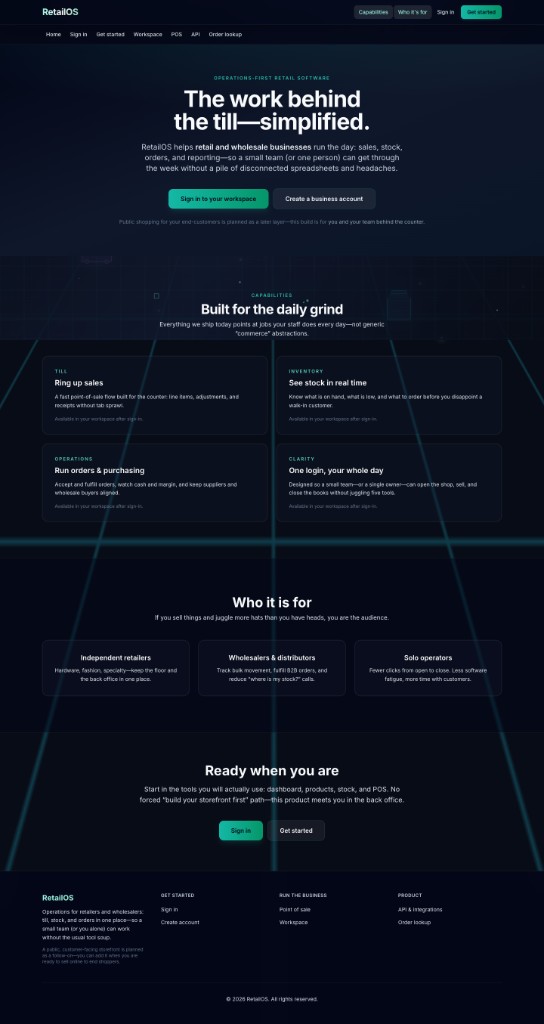
The public B2B landing page leads with the operations story — “The work behind the till—simplified.” It’s designed for owners and staff, with clear CTAs to sign in or create a business account. The copy sets expectations: this is operations software first, and a customer storefront comes later.

The internal catalog is positioned as the range your team buys and sells. It’s intentionally not framed as a public shop yet — the UX supports staff workflows and clean information architecture before consumer-facing browsing.
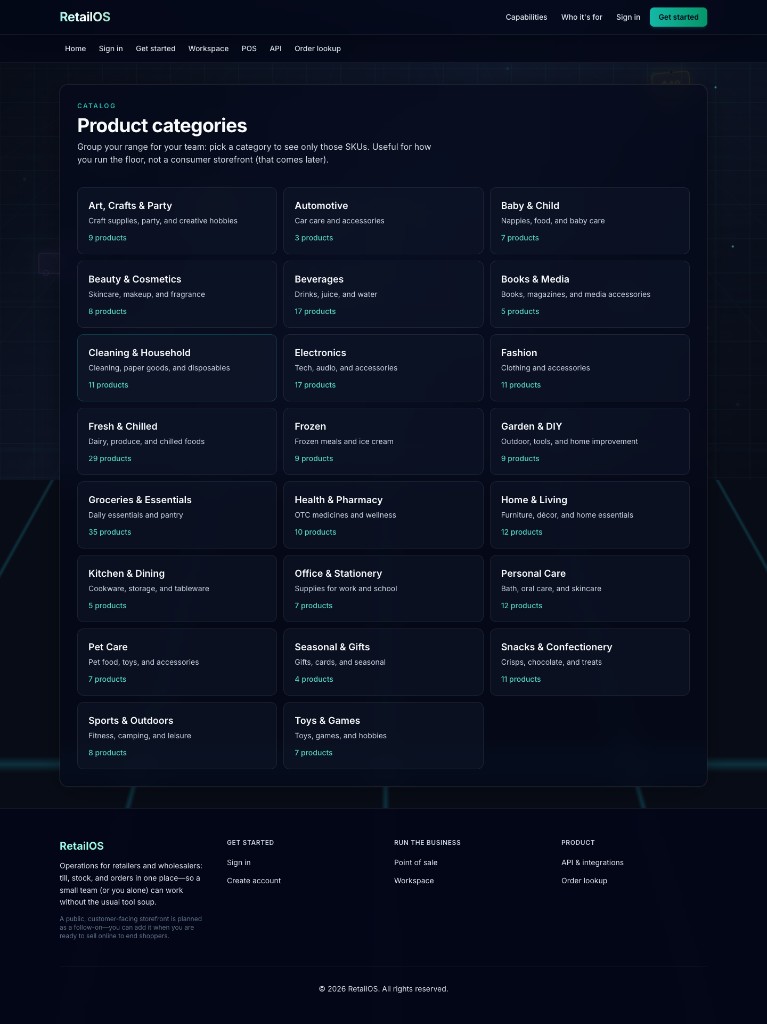
A category index supports merchandising, seasonality, training, and internal navigation — how the team thinks about the range day to day, not just how a shopper browses a storefront.
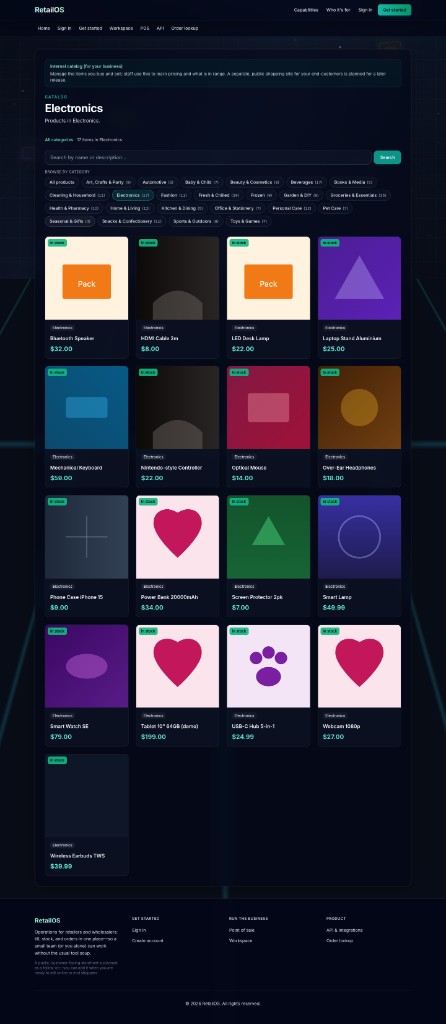
Filtered range views (e.g. by category) let teams focus on a subset of products for a campaign, aisle, or workflow without losing the same internal catalog model.
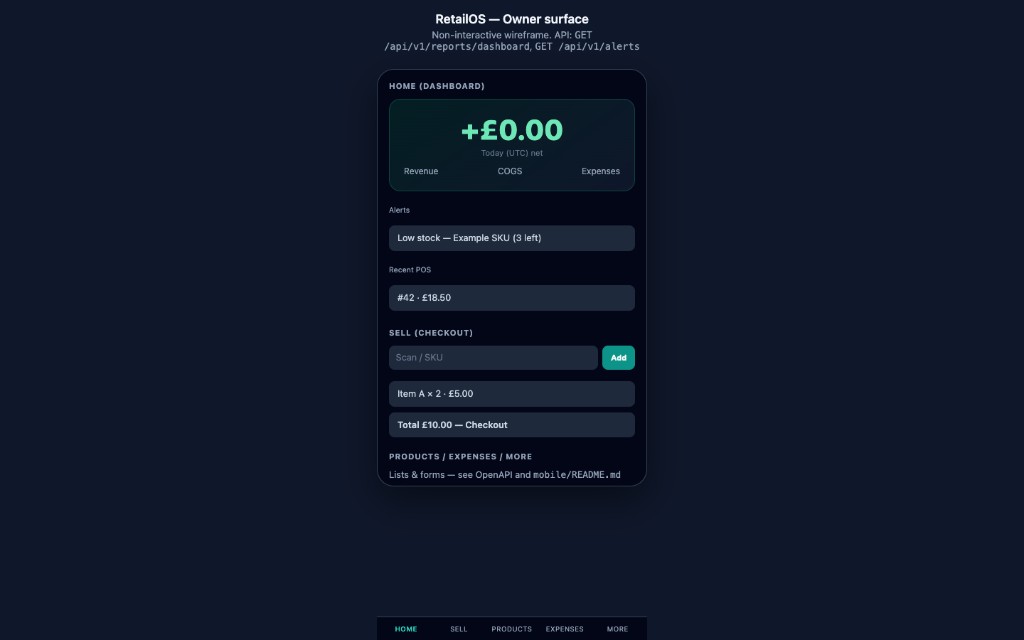
An owner/operator wireframe shows a single mental model across core jobs (dashboard, sell, products, expenses, more). It’s a reference surface that aligns product direction and user expectations.
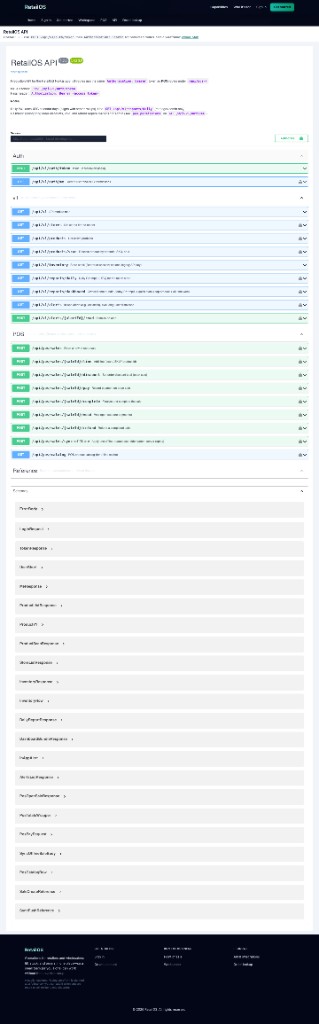
OpenAPI-style documentation makes RetailOS extensible for IT teams and partners — enabling integrations with accounting, ERP, data warehouses, and custom automations.
A branded title interstitial supports decks, demo videos, and case-study storytelling — keeping the product’s visual language consistent across marketing assets.
Product context
RetailOS is an internal product and working demo created to showcase an operations‑first approach to retail and wholesale software — built for owners and staff running the day from the till, stock room, and office. It is presented as a product showcase, not a client claim.
The Problem
Small retail and wholesale teams juggle spreadsheets, separate POS systems, and ad‑hoc tools. Tool sprawl creates duplicate entry, errors, and “software fatigue”—taking time away from customers and cash.
- • Limited staff: one owner or a tiny team must sell, receive stock, answer order questions, and close the books
- • Tool sprawl: different systems for catalog, till, and accounting create errors and duplicate entry
- • Wholesale + retail: teams need accurate range, pricing, and fulfilment status for both buyer types
Our Approach
RetailOS is framed “behind the till” first: one workspace for catalog, inventory, orders, POS surfaces, admin reporting, and documented APIs—so teams can run the day in one consistent UI. A dedicated public storefront is positioned as a follow‑on layer once operations are solid.
Design Principles
- • Operations-first — designed for staff workflows, not consumer shopping as the first screen
- • Clarity — reduce cognitive load with consistent patterns and navigation
- • One source of truth — range, stock and orders flow through one model
- • Extensibility — APIs and docs to integrate with existing stacks
One workspace
- • Catalog
- • Inventory
- • Orders
- • POS surfaces
- • Admin reporting
Wholesale + retail ready
- • Accurate range and pricing
- • Order lookup surfaces
- • Staff-first workflows
Integration path
- • Documented APIs
- • Clear separation for future public storefront
Technical Architecture
Frontend
Backend
Integrations
Operations-first UX (not storefront-first)
Challenge: Most retail software front-loads shopping UX, leaving day-to-day ops fragmented across screens and tools.
Solution: Position the product around the staff workspace first, with a future customer storefront layered later without abandoning the source of truth.
Services demonstrated in this project
What this demonstration shows
RetailOS is presented as an internal product and working demo to show how we approach complex operations software: clear positioning, structured information architecture, workflow-driven UX, and an integration-ready technical foundation.
Independent concept project created by uncodeworld. It was not commissioned by or delivered for an external client.
Related services
This project used or relates to the following services and solutions.